

A potential aviation emergency was averted with calm professionalism last Sunday at Berlin Brandenburg Airport (BER) when a Turkish AJet pilot successfully managed a landing despite a hydraulic failure warning on approach. The incident involved a commercial flight from Ankara to Berlin, carrying 174 passengers, and has since sparked widespread praise from German aviation authorities for the composure and technical precision of the pilot involved.

Hydraulic Failure Detected on Final Approach
The routine flight, operated by Turkish low-cost airline AJet, encountered a serious technical issue as it neared Berlin airspace. The flight captain informed air traffic control that the flaps on the aircraft’s wings—crucial for a safe and controlled landing—were not functioning properly due to a suspected hydraulic system malfunction.
Flaps help an aircraft reduce speed and increase lift during descent. Malfunctions in these components are classified as high-risk events, especially during approach phases, which require precise control and timing.
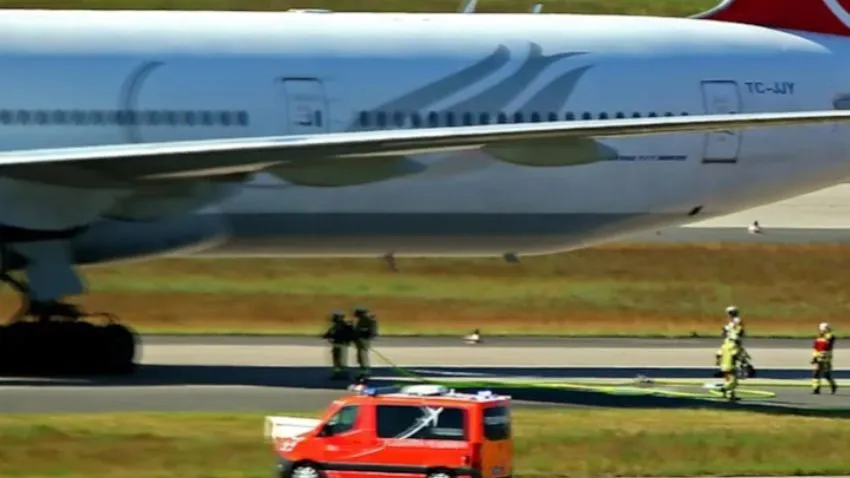
Upon hearing the pilot’s report, Berlin’s air traffic control immediately issued an alert. Emergency medical units, firefighters, and airport rescue teams were swiftly dispatched to standby positions along the assigned runway.
The Pilot Opted for a Go-Around to Ensure Safe Descent
While the airport was enacting emergency landing procedures, the Turkish captain made a tactical decision that would underscore his experience and presence of mind. He executed a go-around maneuver, choosing not to land immediately but instead to circle the airport once more.
This allowed the crew additional time to troubleshoot and reassess the aircraft’s systems while giving emergency teams on the ground more time to prepare. Go-arounds are rarely executed under such high-stress conditions, and when they are, it often reflects strong decision-making under pressure.
Once the situation was deemed manageable, the aircraft returned to approach and performed a textbook landing, touching down smoothly and safely without incident.
Calm in Crisis Leads to International Recognition
After the landing, emergency responders assessed the situation and determined that their intervention was not necessary. The passengers were disembarked safely, and the aircraft was towed for further technical inspection.
Berlin Brandenburg Airport’s control tower then issued a formal commendation to the pilot, saying:
“We thank you for your calm and professional behavior and your flawless landing. Congratulations.”
The message was a rare public expression of gratitude from air traffic controllers to an individual pilot. It not only highlighted the successful conclusion of a potentially dangerous situation but also drew attention to the exceptional standards upheld by Turkish aviation professionals.
The Significance of a Split-Second Decision
In aviation, decisions made within seconds can make the difference between routine landings and tragedy. In this case, the Turkish pilot’s actions—identifying the issue, communicating clearly with the tower, opting for a go-around, and executing a smooth landing—demonstrated exemplary airmanship.
Passengers, while understandably concerned during the event, later praised the crew for keeping them informed and remaining composed. One traveler remarked, “We didn’t even feel the landing. It was clear the pilot was in control the entire time.”
Such accounts not only underscore the captain’s professionalism but also build public trust in Türkiye’s aviation industry, known for producing highly trained and internationally respected flight crews.
Türkiye’s Growing Reputation in Global Aviation
The incident in Berlin brings renewed attention to the strength and reliability of Türkiye’s civil aviation sector. With airlines like Turkish Airlines, Pegasus, and AJet operating on a growing number of international routes, the need for highly capable personnel has never been greater.
Turkish flight academies are recognized globally, and the country’s aviation safety record continues to improve year after year. Events like this serve to reinforce Türkiye’s image as a hub of technical excellence and safety in air transport.
Lessons from the Incident for the Aviation Community
While the emergency landing ended without injuries or damage, it provides an opportunity for the global aviation community to reflect on several key points:
Importance of decision-making under pressure
Value of communication between cockpit and air traffic control
Preparedness of ground emergency teams
Passenger management during potential crises
Maintenance protocols for hydraulic systems
Each emergency response, successful or not, contributes to broader safety learning and future procedural improvements. The Berlin incident will likely be reviewed by both Turkish and German aviation authorities as a case study in effective risk management.
A Proud Moment for Turkish Aviation
While technical malfunctions can happen anywhere, what matters is how they are handled. The Turkish pilot’s response showcased not only skill and professionalism but also the culture of discipline and training that characterizes Türkiye’s aviation sector.
The incident also serves as a powerful reminder that behind every safe landing is a team of trained individuals—pilots, cabin crew, ground staff, and air traffic controllers—working together across borders to ensure public safety.
Such moments, though often unnoticed by the wider public, are the quiet victories that uphold the integrity of global aviation.