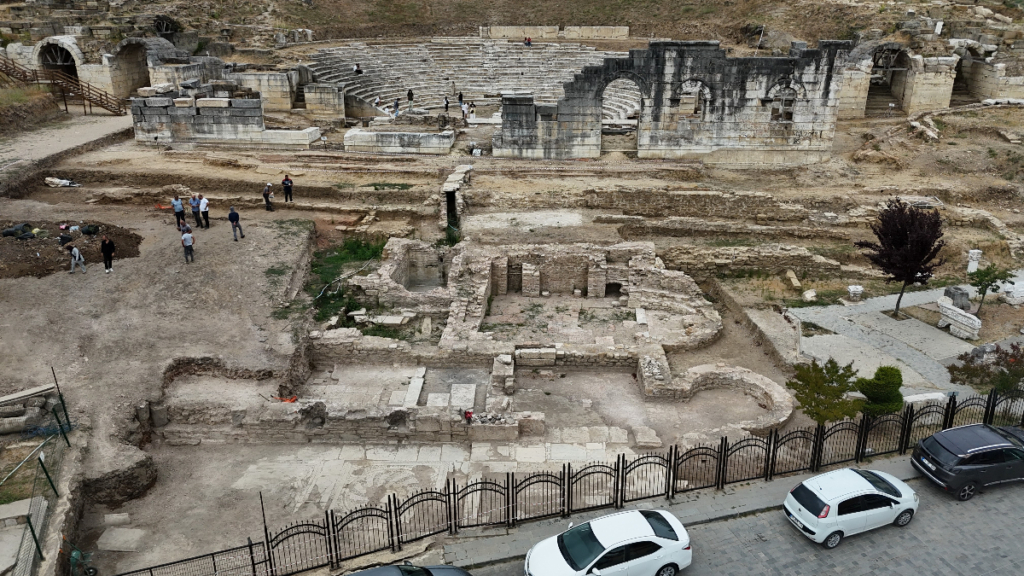

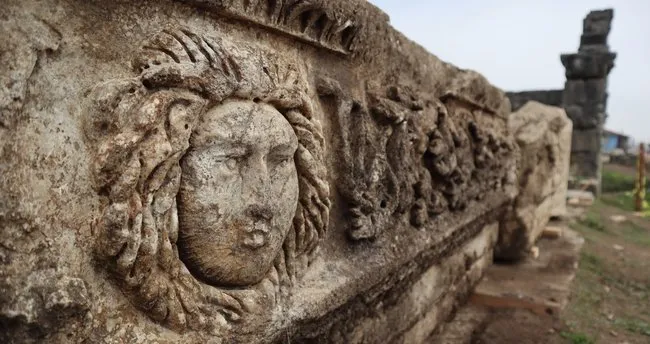
In the hills of Düzce’s Konuralp district, an extraordinary archaeological discovery is shedding new light on the early Christian period in Anatolia. At the heart of the excavation is the ancient theater of Prusias ad Hypium, the only known Roman theater in Türkiye’s western Black Sea region. Recent digs near the northern slope of the site have unearthed what appears to be a significant early Christian religious complex.
This discovery, led by Düzce Municipality in cooperation with Düzce University, not only confirms the layered historical richness of Prusias ad Hypium but also highlights the region’s role in the broader narrative of religious transition from paganism to Christianity during the Byzantine era.
A Sacred Structure with Deep Historical Roots
The archaeological team initially believed they had found a small chapel due to the presence of an east-facing apse. However, as excavations progressed, additional structural features were revealed, including another apse extending toward the south and a large mosaic-paved area. These findings suggest that the site was not just a simple worship space, but part of a more elaborate complex likely used for significant religious functions.
Art historian Raşit Aydın, who provides guided historical interpretation at the site, commented on the significance of the discovery. He noted that the architectural features, including the apse configuration and floor mosaics, indicate the structure likely dates back to the early or middle Byzantine period.
“What started as a single apse was quickly expanded into a wider network of interconnected spaces,” Aydın explained. “This shows that the structure was not just a chapel but part of a larger, possibly multi-purpose ecclesiastical complex.”
Traces of Religious Transformation in Anatolia
The discovery is particularly important for understanding the transformation of religious identity in Anatolia. Prusias ad Hypium, founded in the 3rd century BCE and once part of the Bithynian League, was originally a city rooted in Roman pagan traditions. The transition from pagan temples to Christian places of worship reflects a broader imperial shift that took place across the Roman Empire and its successor, the Byzantine Empire.
According to Aydın, the newly discovered complex likely dates back to the time when the Eastern Roman Empire had officially adopted Christianity but was still influenced by residual pagan customs and architecture.
“Rome was a polytheistic empire. It was during the Byzantine era that Christianity became the dominant faith. The architectural language of this complex reflects that critical moment in history,” Aydın said.
Ancient Theater Nearly Fully Excavated
The ancient theater at Prusias ad Hypium has been the focal point of excavation efforts for several years. Aydın confirmed that approximately 95 percent of the theater structure has now been unearthed. The ongoing goal is to better understand the functions of surrounding buildings, including the newly discovered ecclesiastical site.
The theater, with its well-preserved cavea and stage structure, has already drawn considerable attention from historians and tourists. With the addition of a Christian-era complex nearby, the site now offers a more comprehensive view of cultural continuity and religious transformation spanning centuries.
Architectural and Cultural Importance of the Site
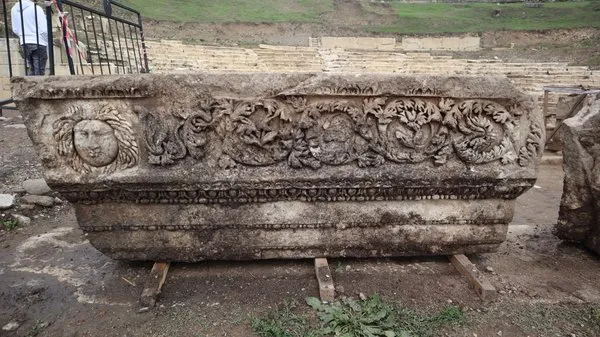
The presence of a mosaic floor within the religious structure adds significant archaeological value. Mosaics were often used in important public and religious buildings, serving both decorative and symbolic functions. Their quality, design, and thematic content can offer insights into the religious iconography, funding sources, and craftsmanship of the time.
The discovery also supports theories that early Christian communities in Anatolia did not always construct new churches from scratch. Instead, they frequently adapted and expanded existing Roman buildings, integrating them into new religious landscapes. This blending of architectural styles and materials symbolizes a pragmatic and gradual shift in spiritual life.
Konuralp as a Cultural and Historical Hub
Once a key city of the Bithynian Kingdom, Prusias ad Hypium was strategically positioned along important trade and military routes. Its urban layout, public buildings, and now early Christian structures indicate that it was more than just a local administrative center. It was a vibrant, multicultural urban space where political, economic, and religious forces intersected.
Today, the Konuralp district of Düzce is emerging as a significant archaeological destination in Türkiye. Local officials hope that continued discoveries will boost cultural tourism and enhance public awareness of the region’s heritage.
Education and Preservation as Core Goals
In partnership with Düzce University, the excavation project emphasizes not only research but also public education and conservation. Students, historians, and volunteers regularly participate in digs, cataloging artifacts and studying architectural features.
Efforts are also being made to preserve the structures in situ and ensure that they are accessible to future generations. The team has been documenting every stage of the excavation through photography, 3D mapping, and detailed architectural drawings, which will eventually be made available to the public and scholarly community.
Conclusion
The discovery of an early Christian worship site near the ancient theater of Prusias ad Hypium offers a fascinating glimpse into Türkiye’s complex religious and cultural history. As archaeologists continue to explore the site, each layer of soil reveals a new chapter in the story of a city that witnessed the rise and fall of empires, the clash of faiths, and the enduring spirit of human belief.
With its mosaics, apses, and sacred silence, this ancient complex stands as a quiet but powerful testimony to a time when the divine was sought not in grandeur, but in carved stone and shared rituals. As the Konuralp excavations progress, the legacy of Prusias ad Hypium is coming into sharper focus, providing an invaluable link between the ancient world and the present day.