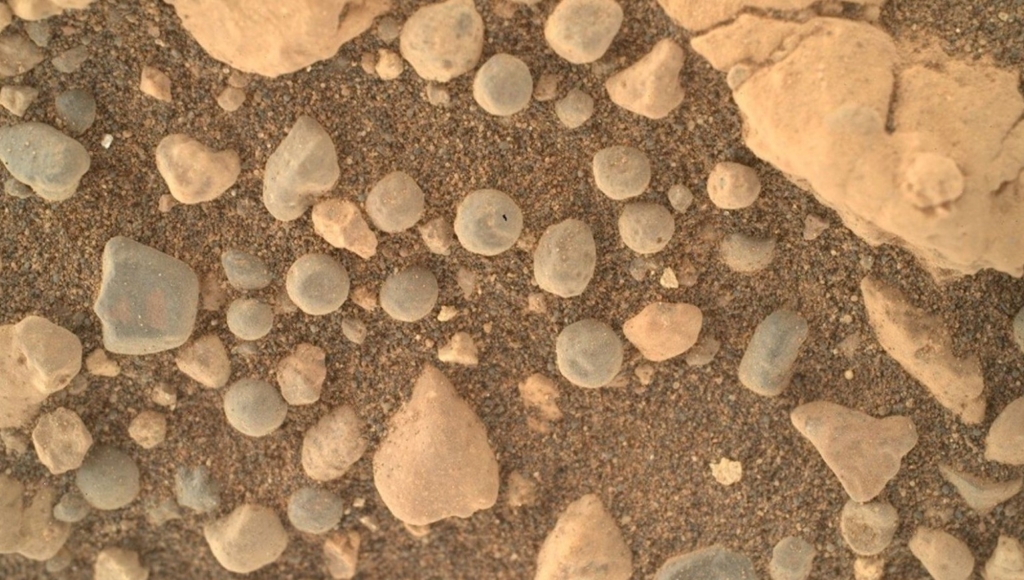

NASA’s Perseverance rover has once again ignited excitement in the scientific community with its discovery of nearly perfect spherical structures on the surface of Mars. These mysterious formations, located near Jezero Crater, offer new insight into the planet’s fiery past, challenging earlier assumptions about Martian geology and raising fresh questions about the forces that shaped the Red Planet.
The spherical formations were spotted in an area nicknamed “Witch Hazel Hill,” a rugged terrain within the crater that Perseverance has been exploring for geological clues. These spheres, some embedded in rock and others scattered across the dusty Martian surface, immediately drew comparisons to the famous “blueberries” discovered by NASA’s Opportunity rover over two decades ago in Meridiani Planum.
But there is a key difference that sets this latest discovery apart. Unlike the Opportunity blueberries, which were formed by water-rich sedimentary processes, these new spheres may have been forged by intense heat—either through volcanic activity or the impact of a cosmic collision.
A Spherical Mystery with Fiery Origins
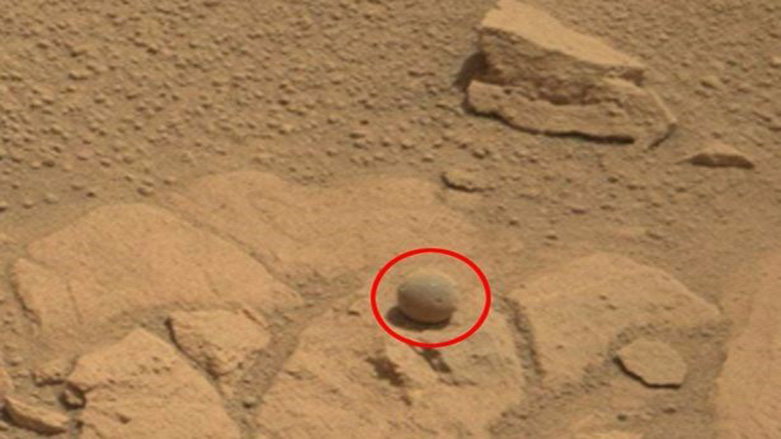
In 2004, the Opportunity rover captured global attention when it discovered tiny spherical iron-rich nodules that scientists dubbed “blueberries.” These features, primarily made of hematite, were found to have formed in wet environments, supporting theories that Mars once hosted liquid water. They became a cornerstone of the argument for a once-habitable Mars.
However, the formations discovered by Perseverance tell a different story.
Initial analysis suggests these spheres have a basaltic composition, a characteristic more commonly associated with volcanic or impact-related origins. Scientists theorize that they may have formed when molten rock was ejected during a meteorite impact or volcanic eruption, cooled rapidly while airborne, and solidified into spherical shapes. This process would be analogous to the formation of terrestrial “impact spherules” or “volcanic bombs” observed on Earth.
This theory significantly expands the range of geological phenomena responsible for shaping Mars’ surface and suggests that the planet’s history is even more dynamic than previously believed.
What Makes the Witch Hazel Hill Spheres So Unique
The site where these spheres were found—Witch Hazel Hill—is particularly intriguing. Located on the edge of Jezero Crater, this region is known for its complex geological layering and potential as a record keeper of ancient Martian activity.
Some of the spheres are partially embedded in rock layers, indicating they may have formed within the subsurface and were later exposed by erosion. Others lie loose on the ground, suggesting they might have been transported or released from surrounding formations. The distribution pattern, structure, and material composition are all currently being analyzed by the rover’s suite of instruments, including the SuperCam, SHERLOC, and PIXL.
NASA scientists are particularly interested in determining whether these spheres originated from a single geological event or if they are part of a more widespread phenomenon. Understanding their origin could provide critical clues about the planet’s geological history, including the frequency and intensity of volcanic eruptions or asteroid impacts.
Water vs. Fire A Tale of Two Martian Histories
The earlier discovery of water-formed hematite spheres created strong evidence supporting the hypothesis that Mars once had a wet and possibly habitable environment. However, these new spheres point to a contrasting narrative—one dominated by fire, force, and high-energy events.
If the spheres at Witch Hazel Hill were formed by a meteorite impact, they could help identify the nature of the impacting body and the mechanics of crater formation on Mars. If they were produced during a volcanic eruption, they could shed light on the intensity and composition of Mars’ ancient volcanic activity, particularly around Jezero Crater.
In either case, the discovery underscores how multiple forces—both aqueous and volcanic—have shaped Mars over billions of years. The planet’s surface may be dry and cold today, but the evidence suggests it once endured both flowing water and explosive geological upheavals.
Implications for Mars Exploration and Sample Return Missions
One of the most exciting aspects of this discovery is its potential impact on future missions, including NASA’s Mars Sample Return campaign. The ability to collect and eventually analyze these spheres in Earth-based laboratories could revolutionize our understanding of Mars’ thermal and mechanical history.
Since Perseverance is designed not just to study the Martian surface but also to collect and cache samples, the inclusion of these spherical structures in its sampling repertoire could be invaluable. Detailed lab-based mineralogical and isotopic studies could reveal formation temperatures, cooling rates, and even the presence of trace elements that hint at the conditions under which they were formed.
NASA has not yet confirmed whether any of these spheres will be targeted for sample return, but the scientific community is already advocating for their inclusion.
Challenging Traditional Narratives of Martian Geology
For years, Mars exploration has focused heavily on identifying signs of past water. From dried riverbeds to mineral deposits and ancient lake basins, the narrative of a “wet Mars” has dominated headlines. While this emphasis is justified—given the potential implications for life—it has also overshadowed other vital geological processes.
The discovery of thermally formed spheres reminds researchers that Mars was not only a planet of water but also one of fire and violence. It broadens the scope of exploration to include high-energy processes that have left equally significant imprints on the planet’s surface.
By examining how Mars’ volcanic and impact history intersects with its hydrological past, scientists can build a more comprehensive timeline of planetary evolution. This multidimensional approach is crucial for understanding not just the Red Planet, but also how Earth and other rocky planets formed and evolved.
Public Fascination and the Future of Mars Science
As images of these spheres make their way into the public eye, interest in Mars exploration continues to surge. The combination of mystery, science, and technological achievement has always captivated audiences, and the Witch Hazel Hill discovery is no exception.
It also raises philosophical questions about the forces that shape worlds. Whether sculpted by the gentle flow of water or the explosive fury of lava and rock, Mars stands as a testament to the diverse processes that drive planetary change.
NASA’s Perseverance mission, equipped with advanced instrumentation and guided by increasingly sophisticated AI and remote systems, is opening new chapters in Martian science. And with each discovery—whether wet, dry, hot, or cold—we get one step closer to answering humanity’s most enduring question: Was Mars ever alive, and could it be again?