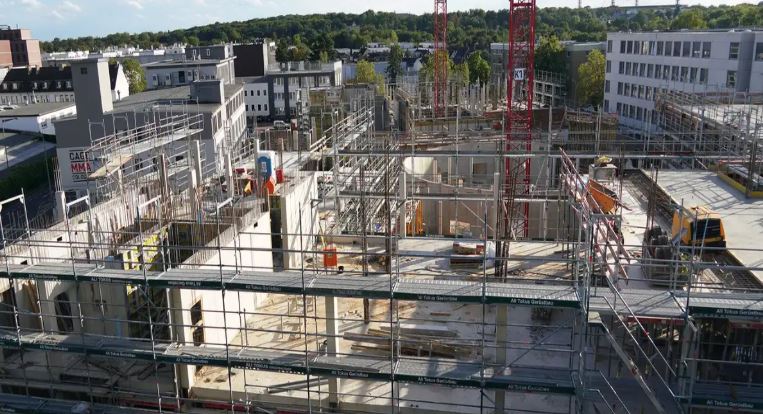

A recent decision in the German town of Leinfelden-Echterdingen, located in the state of Baden-Württemberg, has sparked national debate over religious tolerance, urban planning, and integration policy. The town council has voted to demolish a nearly completed mosque built by a Süleymancı-affiliated cultural association. If carried out, this could mark the first instance of a mosque being officially demolished by a local government in Germany.
The mosque project was initiated in 2014 by the Association for Culture, Education, and Integration (VKBI), which is part of the Islamic Cultural Centers Union (VIKZ)—one of the largest Islamic organizations in Germany with more than 300 mosques and an estimated 100,000 members.
Now, with demolition scheduled to be completed by the end of the year, tensions are rising not only within the local Muslim community but across broader sections of society who see this decision as a symbolic and potentially precedent-setting moment.
![Batman Belediyesi, caminin giderlerini karşılamak için yapılmak istenen yeri yıktı - [İLKHA] İlke Haber Ajansı](https://www.newstimesturkey.com/storage/2025/08/the-congregations-mosque-will-be-demolished-as-the-municipality-takes-unprecedented-action-0-pw1vusmH.jpg)
Legal Dispute Rooted in Construction Deadlines and Planning Conflicts
In 2014, VKBI was granted a legal easement to construct a mosque on municipal land. One key condition was that the construction had to be completed within four years. As delays mounted and negotiations between the association and the city failed to produce a compromise, the municipality rescinded the easement.
The matter was taken to court, culminating in a ruling by the German Federal Court of Justice, which sided with the municipality. This cleared the way for the town council to vote on whether the building should be torn down. A large majority supported the demolition, citing violations of the original agreement, unresolved technical issues, and the association’s persistence in building a student dormitory adjacent to the mosque without proper approvals.
Religious Infrastructure at a Crossroads
The mosque, which had reached a nearly finished state, is now scheduled for destruction, drawing criticism from various civil society organizations, religious leaders, and even urban planning experts. While municipal officials argue that they exhausted all means of mediation and view demolition as a last resort, critics contend that the decision reflects a deeper unease with Muslim visibility in public spaces.
This controversy arrives at a time when Germany is grappling with the future of religious integration, especially within Muslim communities. According to observers, the mosque’s planned destruction raises broader questions about whether local governments are providing equitable access to land, permits, and public support for religious minorities.
Ecological and Social Ramifications of the Demolition
The demolition is not merely an administrative action; it has far-reaching ecological and societal implications. Environmental groups have voiced concern over the waste and emissions associated with dismantling an almost completed building. The local Muslim community, which has invested years of labor and financial resources into the mosque, views the decision as both punitive and exclusionary.
The community also stresses that the mosque was intended not only as a place of worship but also as a community center that would provide educational services and cultural programming to local residents, both Muslim and non-Muslim.
In response, municipal authorities argue that they are exploring alternative locations and are prepared to offer VKBI a new site for construction. However, no formal proposal has been finalized, leaving the future of the community’s plans uncertain.
A New Chapter in Urban and Religious Policy
For many analysts, this case reflects a growing trend in Germany and across Europe where local governance is increasingly entangled with issues of religious infrastructure. Municipalities are expected to balance urban development, ecological sustainability, and integration policy in an environment where religious projects often become politically charged.
The Leinfelden-Echterdingen case brings to light the need for more transparent and consistent planning guidelines when it comes to religious buildings. Critics argue that similar Christian or secular community projects are rarely subjected to the same level of scrutiny, fueling concerns of institutional bias.
While town officials emphasize that their decision was driven purely by legal and technical concerns, the symbolic nature of demolishing a mosque carries weight. For some, it represents a stand for regulatory enforcement. For others, it represents a step backward in building an inclusive, pluralistic society.
Germany’s Muslim Communities and the VIKZ
The mosque in question is connected to the Süleymancı movement, which maintains a strong presence in Germany and operates under the umbrella of the VIKZ. The organization has long advocated for moderate, educationally focused Islam and is known for maintaining student dormitories, Qur’an schools, and religious seminars.
The potential destruction of one of its mosques—particularly under official order—could damage trust between Muslim communities and local governments. Leaders from the VIKZ have voiced disappointment, emphasizing that the mosque project aimed to enrich the cultural and religious landscape of the town, not to sow division.
They also question whether adequate support and guidance were offered by the municipality throughout the building process. VKBI maintains that the delays were due in part to shifting municipal requirements and bureaucratic obstacles.
Public Debate: Integration or Exclusion
Across Germany, this case has reignited the national debate over integration, secularism, and the visibility of Islam in public life. Some politicians and media outlets have portrayed the demolition as necessary enforcement of the rule of law. Others see it as a troubling message to minority communities about their place in German society.
Civil rights organizations warn that such actions, even if legally justified, risk alienating communities already facing discrimination. They urge local governments to practice greater flexibility and cultural sensitivity, particularly when dealing with long-established community organizations.
Calls for a National Framework
This incident has also triggered calls for a national framework to oversee religious infrastructure projects. Proponents argue that religious communities across Germany face inconsistent policies, arbitrary municipal discretion, and a lack of transparency in approval processes.
A standardized federal-level approach could prevent conflicts like the one in Leinfelden-Echterdingen and help municipalities better manage religious diversity in urban development.
Moving Toward Reconciliation
While demolition now seems imminent, community leaders and city officials still have an opportunity to de-escalate tensions. Offering an alternative site that meets the needs of the VKBI community, as promised, could demonstrate goodwill and preserve interfaith harmony in the region.
Such a move would also send an important message about Germany’s commitment to religious freedom, coexistence, and democratic values in increasingly multicultural towns and cities.
As the story continues to unfold, all eyes remain on Leinfelden-Echterdingen—where the future of one mosque now symbolizes much more than just bricks and mortar.