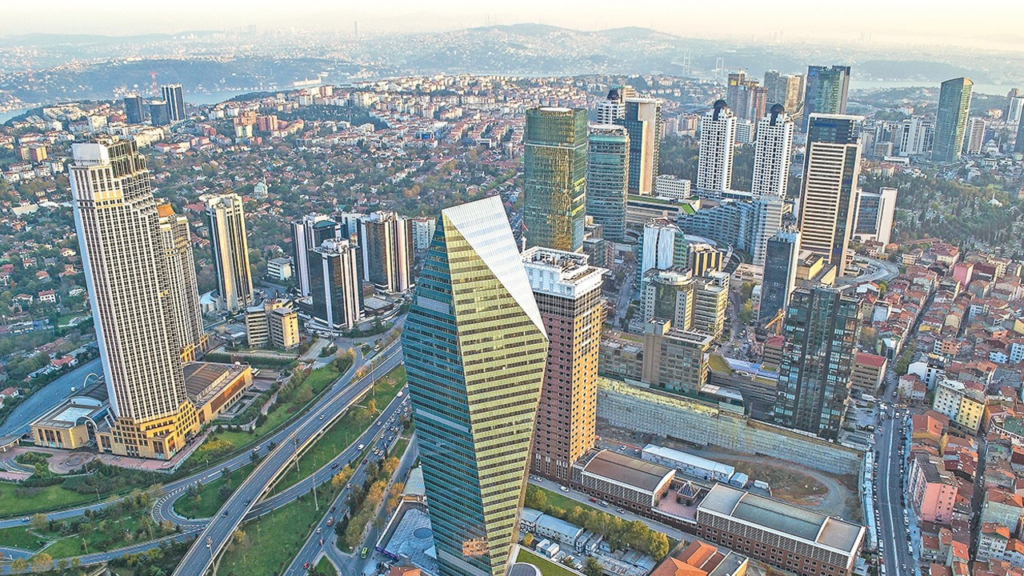

Turkey’s commercial real estate landscape demonstrated notable resilience in the first half of 2025, despite global economic turbulence and mounting geopolitical tensions. The “Real Estate Market Outlook” report released by Cushman & Wakefield TR International reveals that Turkey has maintained its appeal to international investors thanks to a continued economic reform program and a diversified property sector offering strong returns.
A Tight Market Driving Rents to Historic Highs
One of the most striking highlights of the report is the continued escalation in commercial rental values, driven by supply constraints and inflationary pressure. In Q2 2025, prime office rents reached a record-breaking 46 USD per square meter, marking a 10 percent increase in USD terms compared to the same quarter last year. In Turkish lira terms, office rents surged 31 percent, reaching 1,779 TRY per sqm.
Levent led the market as Istanbul’s most expensive business district, followed by Anatolian Side (35 USD), Esentepe-Gayrettepe (32 USD), and Maslak (32 USD). Meanwhile, Ankara and Izmir maintained a steady rental rate of around 20 USD per sqm. The ongoing demand for high-quality office spaces coupled with limited new supply suggests that upward pressure on rents is likely to persist through the rest of the year.
Contract Renewals Outweigh New Lease Activity
The tight rental environment has prompted many tenants to renew existing leases instead of relocating. According to the report, 81 percent of total leasing volume and 62 percent of total deals in Istanbul during H1 2025 consisted of new contracts, indicating a 30 percent decrease in newly signed leases compared to the previous year. This trend underscores the impact of elevated rents on tenant behavior and signals a cautious stance in market expansion strategies.
Vacancy Rates Remain Low
Despite reduced leasing activity, the vacancy rate in the office market edged up only marginally, from 9.8 percent to 9.9 percent, maintaining the market’s overall healthy fundamentals. As long as supply remains restricted and demand for well-located, well-equipped workspaces endures, the office segment is expected to remain robust.
Retail Market Holds Steady Amid Supply Freeze
Turkey’s retail sector showed remarkable stability. In June, prime rents on high streets peaked at 250 USD per sqm in Istanbul, while Ankara and Izmir followed with 105 USD and 100 USD respectively. Despite ongoing demand, no new shopping mall investments were recorded during H1 2025, keeping total retail stock stable at 455 malls and 14.11 million sqm.
This freeze in new development did not dampen market activity. The luxury fashion segment experienced heightened momentum, with international brands increasing their footprint across major Turkish cities. Another area of rapid growth was the third-wave coffee industry, with global and local café chains intensifying competition in urban commercial corridors.
Industrial and Logistics Sector Slows but Remains Active
In contrast to other sectors, the industrial and logistics market witnessed a 33 percent drop in leasing volume compared to the same period last year. Approximately 121,000 sqm of space was leased in H1 2025, pointing to a cautious stance among manufacturers and logistics providers amidst global supply chain disruptions and local economic fluctuations.
Still, demand remains solid in key logistics hubs such as Gebze, Hadımköy, and Tuzla, driven by e-commerce growth and increasing demand for last-mile delivery solutions.
Global Interest Persisting Despite Challenges
While global uncertainty and trade disputes continue to weigh on investment sentiment, the report emphasizes that Turkey remains on the radar of international institutional investors. The ongoing reform-oriented economic strategy, coupled with the country’s strategic geographic location, has sustained a flow of capital into selective asset classes — particularly logistics, prime office, and retail.
A Roadmap for the Future
The “Real Estate Market Outlook” reflects a critical juncture for Turkey’s property sector. With rising inflation and ongoing interest rate uncertainty, the coming months may bring additional volatility. However, sustained demand for premium space, digital transformation in retail, and resilient fundamentals in logistics offer long-term opportunities.
Key Takeaways
Prime office rents reached a record 46 USD/sqm, highest in Turkey’s history.
Leasing activity dropped 30 percent due to high rental costs; renewals dominated the market.
Retail segment held steady with strong interest in luxury fashion and café chains.
No new shopping mall investments were recorded in H1 2025.
Industrial/logistics leasing volume fell 33 percent year-on-year.
Istanbul remained the country’s commercial anchor, followed by Ankara and Izmir.
As Turkey enters the second half of 2025, market players will need to balance cautious optimism with strategic planning, recognizing that resilience, adaptability, and sector-specific insight will define success in a complex yet opportunity-rich environment.