

Türkiye is rapidly evolving into a global hub of high-tech manufacturing and innovation, reaching record-breaking growth figures in the first half of 2025. Aligned with its ambitious “Türkiye Century” goals, the nation is intensifying its efforts to enhance its industrial and production capabilities under the framework of the National Technology Initiative.
Driven by robust investments in R&D centers, design hubs, and technology development zones, Türkiye has witnessed an 88.2% year-on-year surge in high-tech manufacturing as of June 2025—marking the highest level ever recorded in the country’s industrial history.

A Nation Empowered by R&D Ecosystems
At the heart of this transformation lies Türkiye’s expanding R&D landscape. As of July 2025, the country boasts 1,360 active R&D centers, dispersed across 58 cities. Unsurprisingly, İstanbul leads the way with 432 centers, followed by Ankara (155), Kocaeli (140), Bursa (138), and İzmir (105).
These centers are not only geographically diverse but also span across 46 industrial sectors, including automotive, energy, healthcare, banking, HVAC systems, maritime, cosmetics, and more. However, the most prominent areas remain machinery and equipment manufacturing, automotive sub-industry, software development, ICT, and electrical-electronics.
The human capital supporting this ecosystem is significant—more than 89,000 personnel are employed in these centers, contributing to a dynamic innovation network. Roughly 75,000 R&D projects have already been completed nationwide, while over 14,000 are still in progress.
Furthermore, the country’s intellectual property output is equally impressive. Over 16,000 patents have been officially registered through R&D centers, and nearly 30,000 applications are under review. International engagement is also notable, with 249 foreign-partnered firms operating R&D centers in Türkiye.
Technology Development Zones Near 12,000 Firms
Technology Development Zones (TGBs), also known as technoparks, form another pillar of Türkiye’s high-tech strategy. Out of 110 designated zones, 91 are currently operational, while four more are expected to be activated by the end of 2025.
These zones have become vibrant centers of innovation, currently housing 11,858 companies and employing more than 123,000 individuals. Together, they have launched or are managing 84,419 projects—creating an impressive pipeline of technological solutions, products, and services.
The zones have also generated 2,180 registered patents and nearly 5,000 additional applications. They’ve further supported 515 foreign-invested companies and 3,260 startup “incubation” firms. The economic impact is equally notable: these innovation hubs have generated over 1 trillion Turkish Lira in total sales and $14.6 billion in exports.
Additionally, more than 600 utility models and nearly 500 industrial designs have been successfully registered as products of these zones.
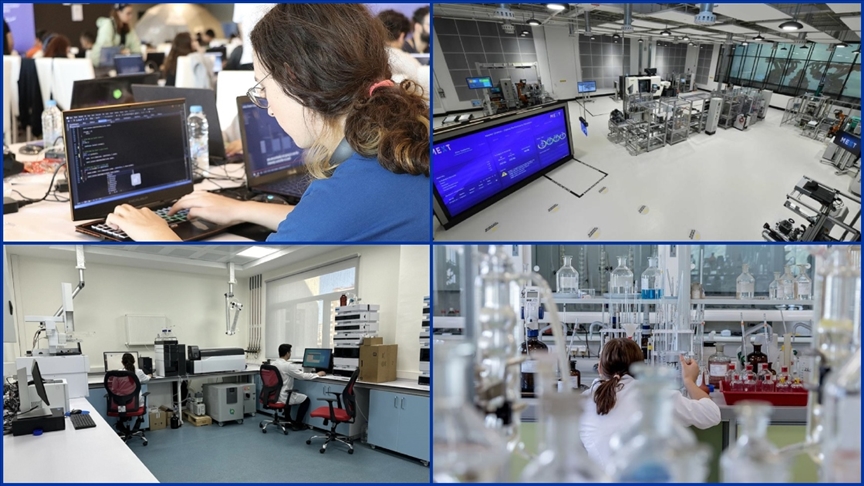
Design Centers Contributing to Product Innovation
Complementing R&D centers and technoparks are Türkiye’s Design Centers, which now number 339. These facilities operate across 29 provinces and focus on creative innovation and applied design in industries such as textile, manufacturing, automotive sub-industries, media, and architecture-engineering.
Employing more than 8,000 skilled professionals, these centers have seen the completion of over 15,000 design-focused projects. The patent landscape here is growing as well, with 342 confirmed registrations and 618 ongoing applications. Furthermore, 42 of these design centers are operated by firms with international partnerships.
The presence of design hubs adds an essential layer of creativity and consumer focus to Türkiye’s high-tech framework, enabling the transformation of engineering breakthroughs into market-ready products that align with user needs and global trends.
The Underlying Strategy: National Technology Vision
All these achievements align with the National Technology Initiative—a strategic roadmap introduced to reduce Türkiye’s dependency on foreign technologies and increase domestic value-added production. By building a robust ecosystem of R&D, design, and manufacturing, the country aims to secure its place among the world’s top industrial powers.
Türkiye’s approach is not limited to isolated investments. It promotes collaboration between government, academia, and industry to ensure the continuity and scalability of innovation. Universities partner with private firms in technoparks, design centers work closely with product development teams, and public incentives are streamlined to encourage sustainable tech production.
Economic and Strategic Implications
The high-tech boom in Türkiye carries far-reaching economic implications. As global supply chains undergo rapid restructuring, countries that can produce high-value, innovative products domestically are positioned to lead. Türkiye’s shift toward localized production of technologies—particularly in sectors such as automotive, energy, health tech, and software—is designed to improve trade balance, increase export competitiveness, and create highly skilled jobs.
Moreover, the 88.2% increase in high-tech production is not just a statistical achievement—it’s a sign of structural transformation in Türkiye’s industrial identity. By transitioning from low-margin, low-tech manufacturing to a model centered on innovation and intellectual property, Türkiye is setting a foundation for long-term economic resilience.
A Blueprint for the Future
The roadmap ahead involves further scaling these initiatives. With thousands of new patents expected, the continued integration of digital tools such as AI, blockchain, and smart manufacturing processes will deepen Türkiye’s competitive edge.
Equally important is the nurturing of talent. Training programs, university-industry collaborations, and entrepreneurship ecosystems will remain at the forefront of policy agendas, ensuring that Türkiye not only builds technologies but also the minds that create them.
Ultimately, the first half of 2025 has demonstrated that Türkiye’s ambitions are not only grounded in vision—but also in action. As more cities become centers of innovation and as more startups find roots in technology zones, Türkiye’s position in the global innovation race is becoming increasingly difficult to ignore.