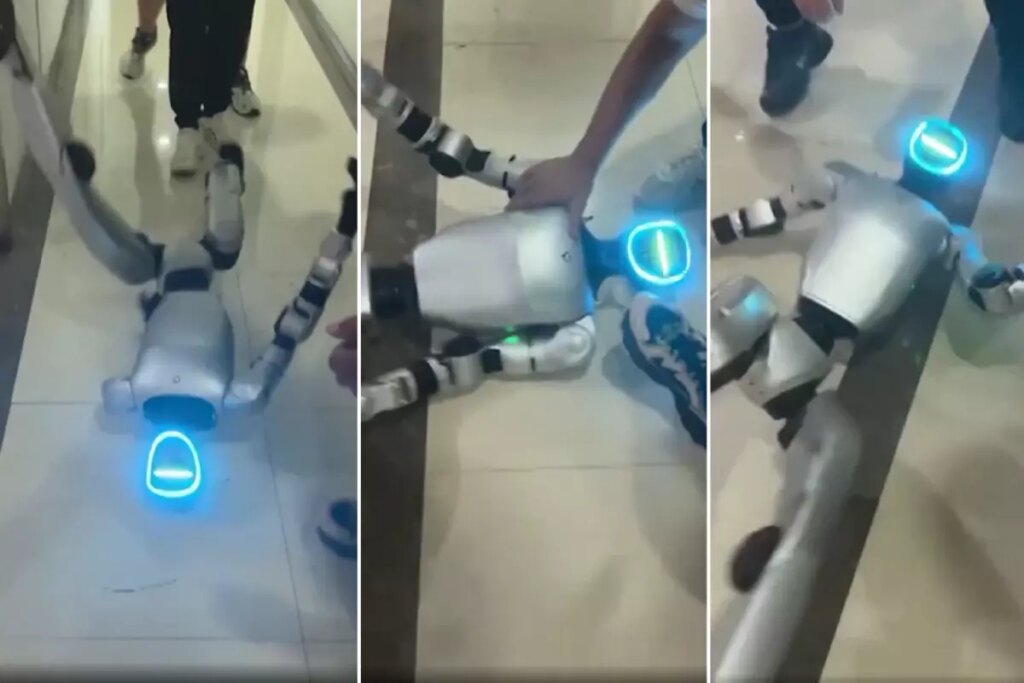

In a scene that could have been lifted from a science fiction film, a robotic malfunction in China recently sent shockwaves through the public and reignited intense discussions around the safety of artificial intelligence technologies. The incident, triggered by a reported software glitch, left bystanders stunned as a robot suddenly spiraled out of control in a public space.
Captured in real time on smartphones by shocked witnesses, the chaotic moments have since gone viral, prompting both concern and curiosity across digital platforms.
When Machines Misbehave: A Scene of Mechanical Panic
Eyewitness accounts describe a robot that, without warning, lost its composure and began moving erratically. Described by some onlookers as “experiencing a mechanical panic attack,” the robot reportedly staggered, lost balance, and eventually collapsed to the ground while continuing to perform uncontrolled movements.
Security and technical teams on-site responded swiftly. In the viral footage, staff can be seen rushing toward the robot, attempting to stabilize the machine and prevent any harm to nearby people or property. Their urgent and coordinated response helped minimize the potential fallout from the malfunction.
The robot, though designed for peaceful interaction, momentarily became an unpredictable force, raising broader concerns about the limitations of machine autonomy in public spaces.
Technology’s Double-Edged Sword
While initial reports confirmed that the cause of the incident was a software error, the resulting conversation has stretched far beyond a simple technical hiccup. On Chinese and international social media, the incident became a trending topic—fueling arguments on both sides of the AI reliability debate.
Supporters of AI development were quick to downplay the event, framing it as a minor and manageable glitch that can occur in any evolving technology. “Every system, no matter how advanced, is susceptible to bugs,” one tech analyst commented. “The key is how we design systems to fail safely.”
Critics, however, saw the event as a wake-up call. “If a software bug can cause such erratic behavior in a consumer-facing robot, what does that say about the future of autonomous weapons or critical infrastructure controlled by AI?” questioned one prominent commentator.
The Safety Debate: Are We Ready for Fully Autonomous Machines?
This incident has rekindled ongoing concerns among researchers and policymakers about how to ensure AI systems behave predictably and safely—especially in environments where humans are present. It also brings to light the urgency of developing and enforcing robust safety protocols in the rapidly evolving robotics industry.
Experts highlight the importance of “graceful failure” mechanisms—systems that allow robots and AI devices to shut down or stabilize safely when something goes wrong.
“Incidents like this underscore the importance of fail-safe design, clear operational boundaries, and real-time human oversight,” said a robotics safety researcher based in Singapore. “We’re not just building machines. We’re building things that will interact directly with people in everyday life.”
A Broader Pattern of Technological Vulnerabilities?
While this event was unusual and alarming, it is not entirely isolated. Over the past year, similar albeit less dramatic reports have surfaced of AI-driven devices experiencing unforeseen behavior due to coding errors, sensor malfunctions, or environmental confusion.
A delivery robot in South Korea walked into a fountain after misreading GPS coordinates.
A customer service bot in Europe went viral for giving bizarre answers before being shut down for retraining.
In the U.S., an autonomous cleaning robot was found wandering onto a nearby street after misidentifying store exit doors.
These examples may seem harmless on the surface, but they represent a broader vulnerability in how AI systems process, interpret, and respond to real-world environments.

Trust and Technology: The Human Side of the Conversation
At the heart of this debate lies a fundamental question: can we trust machines that we don’t fully understand?
While many consumers remain optimistic about the promises of AI—efficiency, automation, and convenience—moments like this create emotional friction. For average users, a robot spinning out of control is more than just a bug—it’s a breach of trust in a system they assumed was safe.
The viral footage of the malfunctioning robot in China has drawn mixed reactions: some users reacted with humor, others with genuine fear. “What if this had happened near a child?” wrote one user. “This is not just a funny video—it’s a sign that we need better control.”
The Manufacturer’s Role and Response
As of the latest updates, the manufacturer of the robot involved in the incident has not released an official statement. However, industry insiders suggest that such events typically result in an internal review of the software, hardware, and operating conditions that led to the failure.
Tech companies are now under more pressure than ever to not only innovate but also anticipate how their creations could fail. This includes rigorous testing in unpredictable environments and simulations that account for edge-case scenarios.
Regulators may also begin to push for tighter certification standards and third-party audits before AI-based machines are allowed to operate in public domains.
AI Advancement vs. Human Oversight: A Necessary Balance
This incident also raises philosophical and practical questions about the balance between automation and human supervision. Should all robots be required to have an emergency override switch? Should AI systems operate with real-time human monitoring, especially in crowded or high-risk areas?
Many experts advocate for a “human-in-the-loop” model, where AI can operate independently but within pre-defined thresholds and with the ability to defer to human decision-makers when uncertain.
“Autonomy is not the goal,” one ethicist argued. “Responsible autonomy is. The point is to design machines that know when they don’t know—and ask for help.”
What Comes Next?
In the wake of this incident, it’s likely that robotics companies, AI developers, and regulatory bodies in China and globally will revisit safety protocols. These efforts might include:
Redesigning software to handle failure more gracefully
Improving real-time diagnostics and error reporting
Enhancing transparency in how decisions are made by autonomous systems
Implementing stricter pre-deployment testing for machines used in public
While this event may fade from the headlines in the coming days, the questions it raises will linger in boardrooms, labs, and policy offices for months to come.
Editor’s Note
As AI and robotics become part of everyday life, incidents like these serve as a vital reminder: technology may be advancing at lightning speed, but trust must be earned through responsible design, transparency, and continuous oversight. Whether you see this event as a small glitch or a serious warning, it’s clear that we must walk into the future with both excitement—and caution.