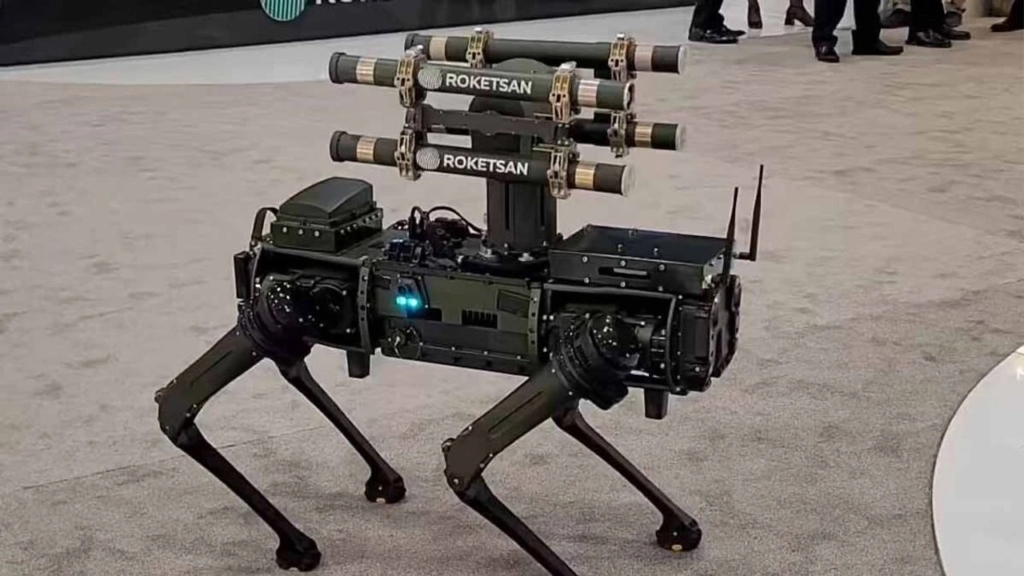

In a bold move that underlines Türkiye’s growing innovation in defense technologies, ROKETSAN has unveiled a groundbreaking robotic system named KOZ. The four-legged unmanned ground vehicle was introduced at the IDEF 2025 International Defense Industry Fair held in Istanbul, capturing global attention with its unique capabilities and futuristic design.
This robot is not just another mechanical marvel—it holds the distinction of being the world’s first robotic dog capable of launching guided rockets. KOZ combines advanced engineering with combat-ready features, signaling a major leap in unmanned warfare systems.
A New Era in Autonomous Combat Systems
The unveiling of KOZ marks a significant advancement in the realm of defense robotics. With its ability to operate autonomously or through remote control, KOZ is built to adapt to modern battlefield conditions. Whether it’s reconnaissance, direct assault, or special operations, KOZ is designed to be mission-flexible and highly mobile.
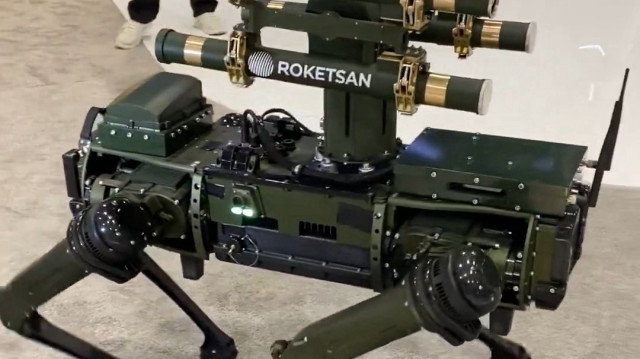
Equipped with four guided missile launchers and powered by ROKETSAN’s proprietary METE Laser-Guided Mini Missile System, KOZ introduces an entirely new category of robotic weaponry. METE, previously deployed in aerial drones and naval unmanned vehicles, now finds a new application in ground combat through KOZ.
Revolutionizing Battlefield Dynamics
One of KOZ’s most distinctive features is its multi-functional use on diverse terrains. Thanks to its four-legged robotic platform, KOZ can traverse rocky, steep, and otherwise inaccessible areas where traditional vehicles or personnel may struggle. This mobility, combined with autonomous navigation and remote operation capability, gives defense forces a tactical advantage in both urban and rural combat scenarios.
Its ability to carry out missions continuously for up to 2.5 hours also enables extended deployments without human intervention. This feature is especially crucial for surveillance and reconnaissance in conflict zones, where exposure to enemy fire must be minimized.
Technical Features That Make KOZ a Game-Changer
The KOZ robotic system is more than just an engineering marvel. Below are some of the standout specifications that define its performance:
Four guided missile capacity: Allows simultaneous or sequential firing depending on mission needs.
Up to 2.5 hours of continuous operation: Ensures reliability in prolonged missions.
Dual-mode operation (autonomous and remote control): Offers flexibility based on tactical requirements.
Stability and mobility on challenging terrain: Built for action in unpredictable environments.
Support for assault, reconnaissance, and specialized missions: Versatile use across a range of defense operations.
These features not only enhance KOZ’s operational effectiveness but also position it as a next-generation solution in Türkiye’s military technology arsenal.
A Leap Forward in Türkiye’s Defense Innovation
Türkiye has steadily built a reputation for developing indigenous defense technologies that are both innovative and strategically valuable. KOZ is a shining example of how local engineering and national defense initiatives can result in world-first accomplishments.
The robot dog is entirely domestically produced, showcasing Türkiye’s commitment to technological independence in defense manufacturing. The collaboration between ROKETSAN and local engineering teams emphasizes the country’s potential to lead in the unmanned systems domain on a global scale.
The Role of METE Missiles in Tactical Missions
A key element in KOZ’s effectiveness is its use of METE missiles—a compact, lightweight missile system developed by ROKETSAN for precision targeting. These laser-guided mini-missiles have a range of 1,000 to 1,250 meters, allowing KOZ to engage targets from a safe distance.
The integration of METE into KOZ’s weapon system reflects Türkiye’s approach to reusing and adapting existing technologies in new platforms, maximizing utility while reducing development costs.
Experts suggest that combining METE’s targeting accuracy with KOZ’s mobility creates a highly responsive and lethal unit for fast-paced tactical environments. This configuration can be especially useful in border control, counter-terrorism, and guerrilla warfare operations.
International Reactions and Strategic Implications
Defense analysts and international observers at the IDEF 2025 fair were quick to highlight KOZ as one of the most innovative exhibits. Many believe that the system signals a shift in how ground-based unmanned systems are perceived and utilized globally.
By being the first robotic dog in the world capable of launching rockets, KOZ may spark similar developments in other countries. However, Türkiye’s head start in this niche area gives it a competitive edge in exports and defense collaborations.
From a strategic standpoint, KOZ’s deployment in military scenarios could drastically reduce human casualties, improve mission efficiency, and introduce a new layer of precision in ground attacks.
The Future of Robotic Warfare
Robotic systems are increasingly becoming central to modern warfare strategies, and KOZ is a testament to that evolution. As artificial intelligence and robotics become more sophisticated, the role of autonomous units in conflict zones is expected to expand dramatically.
KOZ may also pave the way for future developments in swarm robotics, where multiple units can operate together in coordinated missions. This could be particularly useful in urban combat, search and rescue, and intelligence-gathering operations.
Türkiye’s focus on modular, scalable, and mobile robotic platforms like KOZ indicates a forward-thinking approach that aligns with global defense trends.
Conclusion
With the introduction of KOZ, ROKETSAN has taken a giant leap forward in redefining what robotic ground systems can achieve. The robotic dog not only represents the technological prowess of Türkiye’s defense industry but also sets a new global benchmark in unmanned warfare systems.
As the world takes note of KOZ’s capabilities, one thing is clear—Türkiye is no longer a follower in defense innovation but a leader shaping the future of modern combat.