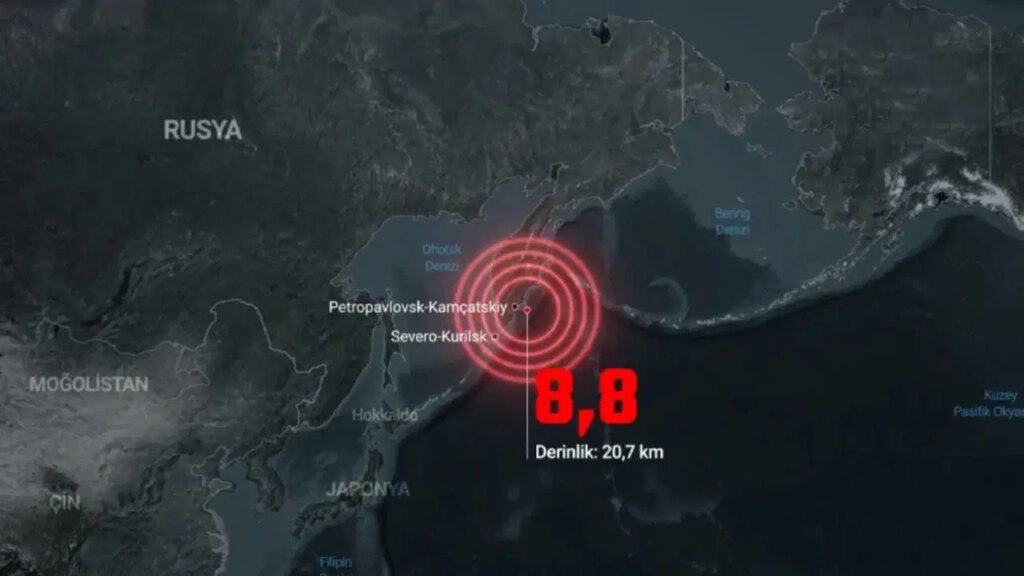

In the early hours of the morning, at 02.25 Türkiye time, a powerful 8.8 magnitude earthquake struck off the coast of Russia’s Kamchatka Peninsula. While the tremor occurred far from Türkiye’s borders, it has reignited a wave of public concern within the country. The prevailing question across social media and public discourse is clear: what if such a massive earthquake had occurred in Türkiye?
This concern is not unfounded. Türkiye, situated at the crossroads of several major fault lines, remains one of the most seismically active countries in the world. In a nation still reeling from the catastrophic February 6 earthquakes that caused widespread devastation and loss of life, the memory of tragedy remains vivid.
A Wake-Up Call for Structural Responsibility
In a recent interview with Cumhuriyet, earthquake expert Prof. Dr. Süleyman Pampal emphasized the urgency of learning from past mistakes. Comparing disaster preparedness to everyday habits, Pampal remarked that just as people instinctively use umbrellas when it rains, they should instinctively construct earthquake-resistant buildings in a country like Türkiye.
He strongly criticized the pattern of repeating the same engineering and policy errors, pointing out that unlike more developed countries that build with resilience in mind, Türkiye continues to make the same fatal miscalculations.
“We keep making the same mistakes 20 to 30 times,” Pampal said, urging policymakers and builders to embrace a culture of safety rather than one of shortcuts and negligence. His words echo a growing consensus among scientists and engineers that Türkiye’s building codes, while theoretically robust, are often poorly enforced or misunderstood in practice.
False Sense of Security in Modern Construction
One of the most alarming aspects highlighted by Pampal is the failure of supposedly earthquake-resistant buildings during the February 6 disaster. Many of these structures were advertised as compliant with modern building regulations, and yet they crumbled under seismic pressure.
“If buildings labeled as earthquake-safe collapsed, it shows we have not truly understood the issue,” Pampal remarked. He criticized the shallow interpretation of construction codes and called for a deeper grasp of the principles behind earthquake engineering.
His comments point to a systemic problem where buildings are often certified on paper but not constructed with the care and materials necessary to truly withstand powerful tremors. This discrepancy between regulation and real-world implementation continues to be a critical vulnerability in Türkiye’s infrastructure.
Seismic Science and the Distance Factor
As for whether the Kamchatka earthquake has any direct impact on Türkiye, Pampal clarified that there is no cause for immediate concern. He explained that the Kamchatka region lies within the Pacific Ring of Fire, a tectonic zone entirely different from the fault systems affecting Türkiye.
“There is a significant geographical and tectonic separation between us and that region,” Pampal explained, highlighting that the seismic waves and aftershocks from the Kamchatka quake are unlikely to influence Türkiye’s seismic stability.
Still, the event serves as a grim reminder of what powerful tectonic movement can produce. For a country like Türkiye, which has experienced numerous deadly earthquakes in recent decades, the Kamchatka quake functions more as a mirror than a menace.
Why Türkiye Cannot Afford to Wait
Earthquake preparedness in Türkiye is often discussed in the aftermath of disaster, but rarely with sustained action. Despite numerous devastating events—from the 1999 İzmit earthquake to the 2023 twin quakes—momentum for structural reform frequently stalls after initial waves of public and governmental attention subside.
Experts argue that Türkiye’s cities, particularly densely populated ones like Istanbul, Ankara, and İzmir, remain highly vulnerable due to a large stock of outdated or improperly constructed buildings. The problem is not only technical but cultural. A shift in mindset is required—one that places safety above cost-cutting and long-term sustainability over short-term profits.
Prof. Pampal’s call to integrate earthquake preparedness into the nation’s architectural philosophy is more than symbolic. It demands a holistic reevaluation of how buildings are designed, approved, and maintained in Türkiye.
The Cost of Ignoring Warnings
Each earthquake, whether domestic or international, offers lessons that should not be ignored. The Kamchatka earthquake presents Türkiye with yet another opportunity to reflect on its own readiness. It exposes a pattern of reactive policies instead of proactive strategies.
In the case of Türkiye, experts suggest that the following steps are urgently needed:
Full enforcement of updated seismic building codes across all municipalities
Retrofitting of existing vulnerable structures, particularly public buildings, hospitals, and schools
Greater investment in earthquake simulation training and drills for both public institutions and the general population
Transparent public communication about risks and emergency procedures
Stricter penalties for construction violations and unsafe practices
These are not merely suggestions—they are necessities. The cost of inaction is measured not only in economic terms but in human lives.
A Lesson in Global Seismic Risk
The Kamchatka quake, despite occurring in a different tectonic setting, is part of a broader pattern of increasing seismic activity around the world. Climate change, while not directly causing earthquakes, may compound their effects through phenomena like soil liquefaction or increased landslide risks in flood-prone regions.
Moreover, global interconnectedness means that disasters in one part of the world can have ripple effects elsewhere, whether through disrupted supply chains, humanitarian responses, or shifts in public perception.
For Türkiye, this is a moment not just for fear, but for foresight. Each tremor should deepen our collective resolve to prepare better and build smarter.
Public Awareness and Education
In addition to structural resilience, public awareness plays a vital role in reducing earthquake damage. Civil society organizations, schools, and local governments must invest in education campaigns that teach basic survival strategies during and after earthquakes.
From knowing how to create safe zones at home to preparing emergency kits, small actions can save lives. Unfortunately, such initiatives often receive attention only in the immediate aftermath of a disaster, then quickly fade from public discourse.
A national strategy to keep earthquake awareness alive year-round—through media, curriculum, and community engagement—would make Türkiye more resilient not only in infrastructure but also in mindset.
Final Reflections from a Nation on Edge
Türkiye may not have felt the ground shake from the Kamchatka quake, but it certainly felt the tremor of memory, fear, and unresolved questions. How prepared are we? How honest are our building practices? And how much longer can we afford to delay true reform?
Prof. Pampal’s warning is clear. Without a philosophical and structural transformation, Türkiye risks repeating the same painful lessons again and again. Earthquakes cannot be stopped—but the destruction they cause can be minimized.
This requires more than policy statements and press releases. It demands a national commitment to resilience, starting now.