
In a landmark publication, the Turkish Statistical Institute (TÜİK) has released its first-ever “Socioeconomic Level 2023” bulletin, offering a comprehensive and data-driven snapshot of household-level socioeconomic status (SES) across the country. This bulletin marks a significant step in understanding how income, education, employment, and other key indicators combine to form the social and economic fabric of Türkiye’s population.
Utilizing extensive administrative records covering more than 26 million households, TÜİK compiled socioeconomic scores based on data from 2022, 2023, and 2024, with mid-2023 serving as the reference point. The result is a nationwide SES map that not only ranks cities (il) but also drills down to district-level (ilçe) disparities—revealing sharp contrasts between Türkiye’s most and least advantaged areas.

What Is Socioeconomic Level and Why Does It Matter?
The newly developed SES index incorporates multiple dimensions of household well-being, such as:
Income levels
Employment status
Educational attainment
Access to public services
Housing conditions
Technological adoption
Rather than isolating economic factors from social indicators, TÜİK’s approach recognizes that socioeconomic well-being is multi-layered and context-specific. The scores provide insights for policymakers, economists, urban planners, and social scientists, enabling more effective targeting of development efforts and public services.
City-Level Findings: İstanbul, Ankara, and İzmir Dominate Top SES Groups
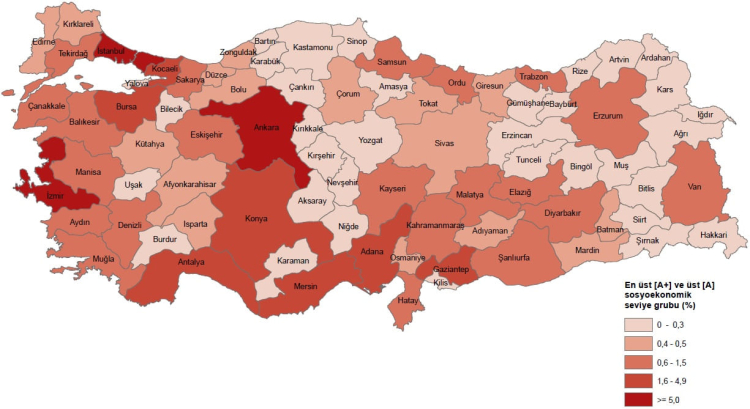
According to the 2023 bulletin, the provinces with the highest proportions of households in the A+ and A (top-tier) socioeconomic groups are:
İstanbul – 28.6%
Ankara – 11.5%
İzmir – 6.7%
Bursa – 3.9%
Antalya – 3.3%
These results reflect the long-established economic hubs of Türkiye, where access to education, healthcare, employment, and infrastructure is generally stronger. The concentration of high-SES households in these provinces supports existing urbanization trends and highlights ongoing regional inequalities.
District-Level Insights: Çankaya, Kadıköy, and Yenimahalle Lead the Rankings
When examined at the district level, the top concentrations of high-SES households are:
Çankaya (Ankara) – 4.1%
Kadıköy (İstanbul) – 2.4%
Yenimahalle (Ankara) – 1.9%
These urban districts are known for their high literacy rates, professional-class residents, modern infrastructure, and strong public service delivery. Çankaya, for example, hosts many government offices, embassies, and universities, which explains its leading position.
In terms of overall average SES scores, the seven highest-ranking districts in Türkiye are:
Çankaya (Ankara)
Kadıköy (İstanbul)
Beşiktaş (İstanbul)
Etimesgut (Ankara)
Nilüfer (Bursa)
Bakırköy (İstanbul)
Güzelbahçe (İzmir)
These districts illustrate a pattern of metropolitan affluence, where investments in education, digital access, and infrastructure have produced a higher quality of life for residents.
The Bottom of the Scale: Rural Disadvantage and Isolation
On the opposite end of the SES spectrum, the seven lowest-scoring districts are:
Çamoluk (Giresun)
Derebucak (Konya)
Doğanşar (Sivas)
Felahiye (Kayseri)
Dikmen (Sinop)
Pınarbaşı (Kastamonu)
Bayramören (Çankırı)
These districts share common features:
Small populations
Geographic isolation
Limited access to healthcare and education
High rates of elderly residents
Lower digital connectivity
The low scores reflect chronic underdevelopment, signaling the need for targeted rural revitalization efforts and investment in infrastructure.
Urban-Rural Divide: A Persistent Challenge
TÜİK’s bulletin reveals a deep and persistent gap between urban centers and rural peripheries. While cities like İstanbul and Ankara continue to accumulate high-SES households, many rural districts lag far behind.
For example, in İstanbul alone, nearly one in three high-SES households is located. In stark contrast, some northeastern and central Anatolian districts score at the bottom 5% of the SES scale, facing limited access to opportunities.
This urban-rural imbalance affects more than just income—it translates into disparities in:
Digital literacy and internet access
Health outcomes and life expectancy
Youth retention and migration patterns
Housing quality and public safety
What Can Policymakers Learn from This Data?
The “Socioeconomic Level 2023” bulletin offers more than rankings; it is a tool for evidence-based decision-making. National and local authorities can use these SES scores to:
Design equitable public spending policies
Identify underserved regions for infrastructure investment
Target education and job training programs to low-SES areas
Track the impact of regional development plans over time
For example, while cities like Bursa and Antalya are steadily rising in SES rankings due to economic diversification and tourism, some Anatolian towns require sustained policy support to catch up.
A New Era of Data-Driven Social Policy in Türkiye
TÜİK’s decision to publicly share a household-level SES index signals a new phase in social policy transparency. By making such granular data available, the institute empowers:
Academic institutions to conduct comparative regional studies
NGOs and civil society to plan community support programs
Investors and developers to identify areas of growth or need
Citizens to better understand their own communities
The agency is expected to update the bulletin annually, allowing for year-on-year comparisons and trend analysis.
Implications for Urban Planning and Economic Development
Urban planners, economists, and sociologists will find this SES data particularly valuable in:
Mapping migration trends
Evaluating gentrification or urban decay
Prioritizing areas for housing or transportation projects
Assessing economic resilience during global disruptions (e.g., pandemics)
Districts with high SES scores tend to attract investment, while low-scoring regions may be left behind unless inclusive development policies are enforced.
Public Reaction and Future Prospects
The release of the bulletin has sparked interest among researchers, think tanks, and local governments, many of which are now re-evaluating their social programs and urban development strategies.
Public curiosity is also high, with residents inquiring about how their neighborhoods rank. As more people engage with SES data, citizen awareness of social inequality may grow, adding pressure on authorities to act.
Going forward, experts are calling for the integration of climate vulnerability, immigration, and youth unemployment metrics into future SES bulletins for a more holistic view.
From Numbers to Nationwide Action
The “Socioeconomic Level 2023” bulletin by TÜİK is more than just a statistical exercise—it is a mirror reflecting Türkiye’s socio-spatial inequalities and a roadmap for inclusive progress. By identifying which regions flourish and which are left behind, the report offers a starting point for more balanced and fair public policy.
As Türkiye continues its path toward sustainable development, this data will play a critical role in shaping a society where every household—regardless of province or district—has access to opportunity and quality of life.