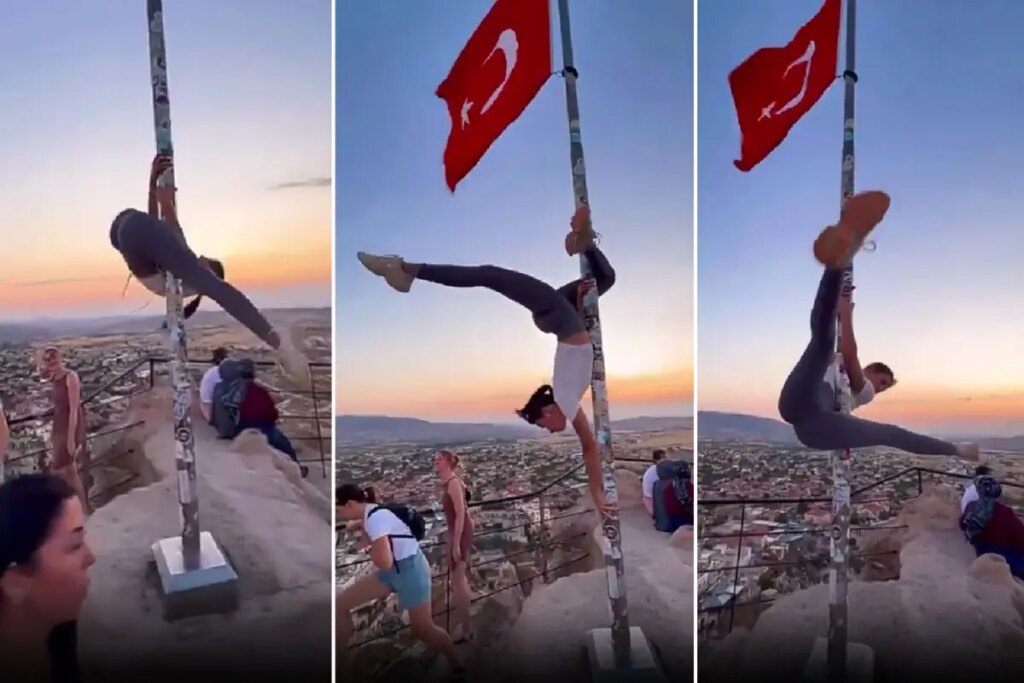

A controversial incident in the town of Uçhisar in Nevşehir has sparked widespread public debate after footage emerged online showing a foreign national dancing on a Turkish flagpole. The video quickly circulated on social media, drawing sharp criticism from citizens who viewed the act as a sign of disrespect toward Türkiye’s national symbols.

Authorities Respond Swiftly
The Nevşehir Governorship issued an official statement after the footage gained attention, announcing that an investigation had been launched regarding the incident. Security units were immediately mobilized to review and verify the details of the video.
The statement emphasized that a criminal complaint had been filed against the individual involved, and the Nevşehir Chief Public Prosecutor’s Office had initiated legal proceedings under Articles 300 and 301 of the Turkish Penal Code. These articles specifically address offenses against the symbols of state sovereignty and insults to the Turkish nation, underscoring the seriousness with which the authorities view the case.
Official Statement from the Governorship
The declaration released by the Governorship read:
“Following reports in certain media outlets and posts on social media, it has been confirmed that in the district of Uçhisar, a foreign national engaged in inappropriate behavior on a Turkish Flagpole. After prompt investigations and identification efforts conducted by our security units, a criminal complaint was filed. The Nevşehir Chief Public Prosecutor’s Office has launched judicial proceedings under Articles 300 and 301 of the Turkish Penal Code.
This incident, which we regard as an act of disrespect toward the national and moral values of our cherished nation, is being followed closely and with sensitivity by our Governorship. Respectfully announced to the public.”
Broader Reactions and Sensitivity
The event comes at a time when public sensitivity to national symbols remains high. Across Türkiye, acts deemed disrespectful toward the flag, anthem, or other state emblems often provoke strong reactions. The Nevşehir incident has reignited discussions about cultural awareness, the responsibilities of foreign visitors, and the importance of respecting the traditions and values of the host country.
Local residents and social media users expressed frustration, pointing out that such behavior damages the spirit of hospitality that Türkiye is known for. Many also called for stricter measures to ensure that similar incidents do not occur again.
Legal and Cultural Implications
Articles 300 and 301 of the Turkish Penal Code are often cited in cases involving the protection of state symbols and national identity. While Article 300 specifically addresses offenses against the Turkish flag and other state emblems, Article 301 relates to acts perceived as insulting the Turkish nation, state institutions, or sovereignty.
The legal proceedings initiated in Nevşehir are expected to clarify the extent of accountability and potential penalties for the individual involved. Beyond the legal framework, the case highlights the cultural significance of the Turkish flag, which holds deep historical and emotional value for the people of Türkiye.
Looking Ahead
As the investigation continues, authorities in Nevşehir have pledged to handle the matter with diligence and transparency. The incident is likely to remain a topic of public conversation, raising broader questions about respect for cultural values, the responsibilities of guests in foreign lands, and the role of law in protecting national dignity.
For Türkiye, the response also reflects a wider commitment to safeguarding its national and moral values while maintaining the principles of justice.