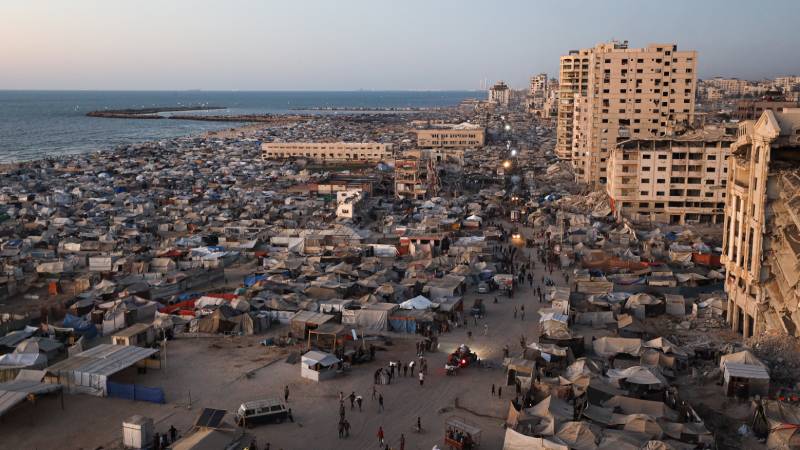

According to an exclusive report by The Washington Post, the Trump administration developed a detailed plan envisioning Gaza as a trusteeship territory under US control for at least ten years. The 38-page proposal outlines a sweeping transformation of the war-torn enclave into a hub for tourism, high-tech industry, and artificial intelligence-driven urban development.
The plan suggests that more than two million Palestinians currently living in Gaza would either be “voluntarily” relocated to other countries or temporarily moved into restricted safe zones within the territory during the reconstruction process.
A Token System for Landowners
One of the most striking elements of the proposal is the introduction of a digital “land token” system. Palestinian landowners would be offered these tokens in exchange for their property rights. These could then be redeemed either for financial support to establish new lives elsewhere or to purchase apartments in one of six to eight planned AI-powered “smart cities” within Gaza.
Families that remain, or those who depart and later return, would eventually be allocated new apartments, each estimated to be worth $75,000 and measuring approximately 1,800 square meters.
The initiative would be managed by an entity named the Gaza Reconstruction, Economic Acceleration, and Transformation Trust (GREAT Trust), spearheaded by individuals who previously set up the Gaza Humanitarian Foundation (GHF), an aid organization supported by both the US and Israel.
Financing Through Mega Projects, Not US Aid
Perhaps the most unusual aspect of the plan is its reliance on private and foreign investment rather than direct US funding. Mega projects — ranging from electric vehicle factories and data centers to luxury coastal resorts and high-rise apartments — would serve as the backbone of financing.
The projections forecast $100 billion in investment over ten years, promising a fourfold return and the creation of a self-sustaining revenue stream. Initial costs would be covered by leveraging 30 percent of Gaza’s territory as collateral.
Regional Mega Projects and Symbolic Naming
Among the proposed projects are a ring road and tram system around Gaza, including a highway named after Saudi Crown Prince Mohammed bin Salman, dubbed the “MBS Highway.” Another major north-south highway would bear the name of UAE President Mohammed bin Zayed al-Nahyan.
In the south, a new seaport and airport would directly connect Gaza to Egypt, Saudi Arabia, and Israel. Additionally, a water desalination plant and a solar energy facility are planned for Egypt’s Sinai Peninsula to supply power and clean water to Gaza.
On Gaza’s eastern border, developers envision a smart industrial zone featuring American electric vehicle companies and regional data centers. Meanwhile, the Mediterranean coastline would host artificial islands modeled after Dubai’s palm-shaped developments, marketed as the “Gaza Trump Riviera,” designed to attract global tourists.
Israel’s Role in Security and Governance
Under the plan, Israel would formally hand over administrative authority in Gaza to the GREAT Trust through a bilateral agreement with the United States. In the first year, Israel would retain broad security rights, but internal security would largely be managed by third-country nationals and Western private contractors.
Their presence would gradually decrease over a decade, with local police forces assuming responsibility as they undergo training. The GREAT Trust would govern Gaza for ten years, until what the plan describes as a “reformed and de-radicalized” Palestinian authority is deemed ready to assume control. Notably, the document does not mention the establishment of an independent Palestinian state.
Diplomatic Implications and Abraham Accords
The proposal also envisages Palestinian participation in the Abraham Accords, the 2020 agreements brokered during Trump’s presidency that normalized relations between Israel and several Arab states. This element suggests an attempt to integrate Gaza into a broader geopolitical framework of regional cooperation.
Why the United States Cares
The report highlights Washington’s strategic interests in Gaza. Beyond its symbolic and political importance, Gaza could serve as a logistical hub for the India-Middle East-Europe Economic Corridor (IMEC), first announced under President Joe Biden but disrupted by the outbreak of the Israel-Gaza war.
The plan also underscores access to vital resources, as the region is considered a gateway for the US to secure energy supplies and critical minerals.
Controversy and Unanswered Questions
The revelations have sparked heated debate. Critics argue that the plan disregards Palestinian sovereignty and risks deepening displacement under the guise of economic development. The token-based land exchange and AI-driven smart city vision raise questions about feasibility and the ethics of forced relocation.
Supporters of the plan, however, frame it as a pragmatic blueprint for rebuilding Gaza and integrating it into regional economic networks, thereby reducing conflict potential through prosperity.
Yet fundamental issues remain unresolved: Would Palestinians accept such a trusteeship? Could foreign investors sustain long-term commitments in a politically volatile region? And perhaps most crucially, would this plan bring peace or entrench new divisions?
Editor’s Note: The Washington Post’s findings shed light on a controversial blueprint that reflects the intersection of politics, economics, and human survival in Gaza. While ambitious in scope, the plan raises profound ethical and political dilemmas that will continue to shape debates over the future of the territory.