

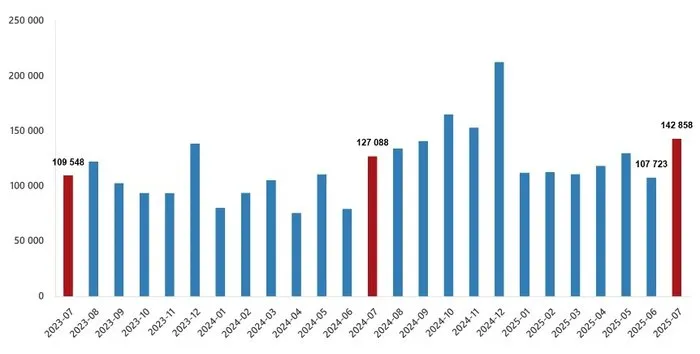
Türkiye’s property market experienced significant momentum in July, with home sales showing a double-digit increase compared to the same month last year. According to data released by the Turkish Statistical Institute (TÜİK), nationwide housing sales rose by 12.4 percent year-on-year, reaching 142,858 units.
Istanbul maintained its position as the country’s top-performing market, recording 23,152 transactions. Ankara followed with 12,491 sales, while İzmir secured the third spot with 7,815 sales. At the opposite end of the scale, Ardahan had the fewest transactions with just 58 homes sold, followed by Bayburt with 93 and Hakkari with 103.
In the first seven months of 2025, Türkiye saw 834,751 homes sold, marking a 24.2 percent increase compared to the same period in 2024. This upward trend reflects a robust domestic demand supported by economic and demographic factors.
Foreign Demand Shows a Notable Decline
While overall sales surged, the foreign buyer segment experienced a contraction. In July, 1,913 homes were sold to international buyers, representing an 18.6 percent drop compared to July 2024. Foreign transactions accounted for just 1.3 percent of all sales during the month.
Istanbul led the way with 643 homes sold to foreign nationals, followed closely by Antalya with 642 and Mersin with 175. From January to July, foreign purchases totaled 11,267 units, down 12.1 percent year-on-year.
By nationality, Russian citizens topped the list with 315 home purchases in July, followed by buyers from Iran (152) and Germany (135). The ongoing geopolitical and economic climate, as well as changes in investment conditions, are likely influencing this trend.
Mortgage-Backed Sales Surge Over 60 Percent
One of the most striking figures in the report was the surge in mortgage-backed sales. In July, 18,425 homes were purchased with a mortgage, marking a 60.3 percent increase from the same month last year. This segment accounted for 12.9 percent of total transactions nationwide.
For the January–July period, mortgage sales reached 121,515 units, up an impressive 93.2 percent from 2024. Of these, 4,438 transactions in July and 28,884 in the first seven months were first-time (new) sales, indicating a strong appetite for financing among new homebuyers.
Other Housing Sales Remain Dominant
Aside from mortgage-backed transactions, “other” housing sales — which include cash and alternative financing deals — made up the bulk of the market. In July, this segment increased by 7.6 percent year-on-year to 124,433 units, representing 87.1 percent of all transactions.
From January to July, other sales grew 17.1 percent to 713,236 units, reflecting the stability of non-mortgage financing in Türkiye’s property market.
First-Hand Sales and New Construction Trends
First-hand home sales — often a key indicator of construction sector performance — saw a 7.8 percent annual increase in July, reaching 43,984 units. This segment represented 30.8 percent of total sales. In the first seven months, first-hand sales rose 17.5 percent to 251,608 units, suggesting developers are still benefiting from steady demand.
The strong figures also highlight the role of newly built housing projects in meeting the needs of Türkiye’s growing population and urban development goals. Many metropolitan areas, particularly Istanbul and Ankara, are seeing large-scale residential projects that cater to both middle-income and high-end buyers.
Second-Hand Sales Continue to Dominate the Market
The bulk of transactions still came from second-hand properties. In July, second-hand sales climbed 14.6 percent year-on-year to 98,874 units, making up 69.2 percent of the total market.
From January to July, the second-hand segment recorded a 27.3 percent surge to 583,143 units. This dominance underscores the maturity of Türkiye’s resale housing market, where buyers often find better pricing and immediate availability compared to new builds.
Market Drivers and Economic Context
Several factors are driving the current housing momentum. High inflation has prompted many to turn to real estate as a hedge against currency depreciation. Urban migration patterns, driven by employment opportunities in major cities, also contribute to demand.
The sharp rise in mortgage sales suggests that recent interest rate adjustments and targeted loan campaigns are making financing more attractive, at least for certain buyer groups. At the same time, the decline in foreign sales points to shifting investment strategies among international buyers, who may be weighing market volatility, policy changes, and currency fluctuations before committing to purchases.
Outlook for the Remainder of the Year
Analysts predict that the housing market’s performance in the second half of the year will depend on several variables, including monetary policy decisions, consumer confidence, and new government regulations affecting the real estate sector.
If domestic demand continues to outpace supply in certain regions, particularly in metropolitan areas, prices could see upward pressure despite broader economic challenges. However, a further slowdown in foreign transactions could temper growth in coastal and touristic markets that traditionally rely on international buyers.
As Türkiye navigates its evolving economic landscape, the housing sector remains one of its most dynamic industries — balancing strong domestic demand with fluctuating global interest. Whether the current momentum translates into long-term stability will largely depend on economic resilience, policy direction, and continued adaptability within the market.