
Türkiye’s foreign trade activity showed notable improvement in July 2025, as both exports and imports experienced year-over-year increases. According to the latest figures released by the Turkish Statistical Institute (TÜİK) in cooperation with the Ministry of Trade, the country’s export performance continued its upward trend, narrowing the trade deficit despite ongoing global economic pressures.
The report, based on the general trade system, reveals a dynamic shift in Türkiye’s external trade landscape, driven by a robust manufacturing sector, expanding export markets, and increasing demand for capital and intermediate goods.
Exports Outpace Imports, Trade Deficit Narrows
In July 2025, Türkiye’s exports rose by 11 percent compared to the same month last year, reaching $24.94 billion. Imports, meanwhile, increased by 5.4 percent, totaling $31.38 billion. As a result, the monthly trade deficit narrowed by 11.8 percent, landing at $6.44 billion.
When excluding energy products and non-monetary gold, exports saw an even stronger growth of 12.8 percent, hitting $23.1 billion, while imports climbed 7.7 percent, totaling $25.3 billion in this adjusted calculation.
This trend suggests that Türkiye’s trade performance is becoming increasingly resilient to global commodity price fluctuations, and that the country’s non-energy export sectors are thriving.
Consistent Growth but Expanding Deficit
In the first seven months of 2025, Türkiye’s exports increased by 5.1 percent, amounting to $156.3 billion, while imports surged by 6.9 percent, reaching $212.2 billion. However, the trade deficit for this period expanded by 12.2 percent, totaling $55.9 billion.
Although the growing deficit presents challenges, the export figures indicate a healthy trajectory for key sectors, and the overall trade environment remains active and expanding.
Sectoral Breakdown: Manufacturing Continues to Dominate
Türkiye’s export portfolio remains dominated by the manufacturing industry, which accounted for 95.5 percent of total exports in July. This is a clear reflection of the country’s industrial strength and the global competitiveness of its manufactured goods.
Agriculture, forestry, and fishing represented 2.2 percent of total exports
Mining and quarrying contributed 1.6 percent
On the import side:
Intermediate goods made up the largest portion at 65.2 percent
Capital goods accounted for 17.2 percent
Consumer goods followed closely at 17.0 percent
These figures underscore Türkiye’s positioning as both a production hub and a key player in international supply chains.
Türkiye Deepens Ties with Europe and Asia
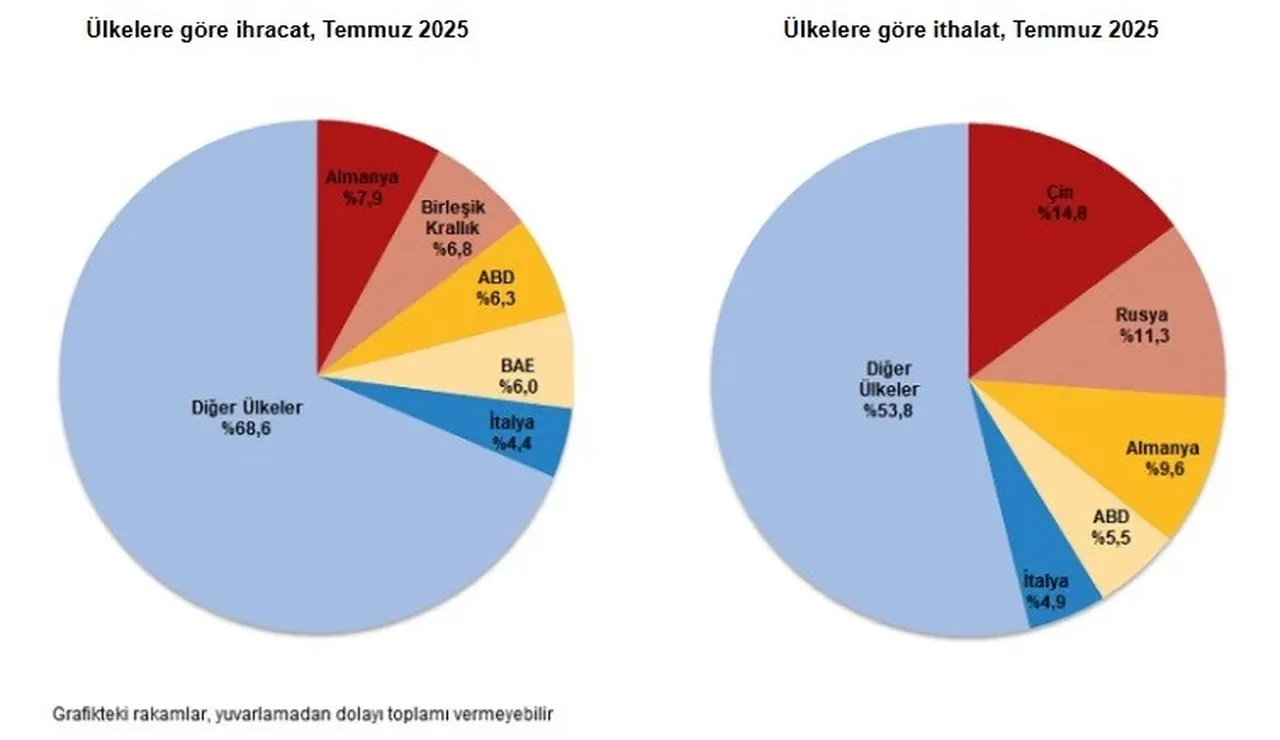
In July, Germany retained its position as Türkiye’s top export destination, followed by:
United Kingdom
United States
United Arab Emirates
Italy
This lineup reflects Türkiye’s balanced outreach across European, Middle Eastern, and North American markets.
For imports, China continued to lead, highlighting the country’s critical role in supplying raw materials and industrial components to Türkiye. The top five import sources were:
China
Russia
Germany
United States
Italy
This structure reinforces Türkiye’s global integration, with strong ties to both regional partners and major global economies.
Room for Growth in Export Value
Türkiye’s efforts to boost high-value production are still in the early stages. In July, high-tech products accounted for just 4.2 percent of total manufacturing exports, indicating significant room for future growth. However, high-tech imports made up 12.7 percent, reflecting Türkiye’s reliance on imported advanced technologies.
The disparity suggests an opportunity for Türkiye to invest further in R&D and innovation to reduce dependency and climb the value chain in export markets.

Positive Trends in Export Performance
When seasonally and calendar-adjusted data is considered:
Exports rose by 8.5 percent
Imports decreased by 5.8 percent
This adjusted view reflects the underlying strength of Türkiye’s export momentum while suggesting some softening in domestic demand or delayed import flows due to global logistics adjustments.
Special Trade System Data
Under the special trade system, which excludes customs warehouse and free zone transactions, July 2025 exports were recorded at $22.65 billion, and imports at $29.39 billion. The trade deficit under this system decreased 0.4 percent to $6.74 billion.
This secondary measurement confirms the trend of narrowing deficits and reinforces the robustness of Türkiye’s trade growth across different accounting frameworks.
What’s Driving the Growth?
Several factors are contributing to Türkiye’s trade expansion:
Global diversification: Turkish companies have been expanding to non-traditional markets in Asia, Africa, and Latin America.
Currency dynamics: A relatively competitive lira continues to support export competitiveness.
Policy incentives: Government programs aimed at supporting exporters—particularly in manufacturing and agriculture—are bearing fruit.
Infrastructure improvements: Logistics and port upgrades have enhanced Türkiye’s ability to deliver goods more efficiently to international markets.
Challenges on the Horizon
Despite positive signs, Türkiye still faces notable headwinds:
Energy dependency: The trade balance remains vulnerable to global energy price volatility.
Import-driven manufacturing: A significant share of exports relies on imported intermediate goods, which means rising import costs can erode margins.
High-tech gap: The country still imports the bulk of its advanced technology needs, limiting innovation-based export growth.
Global economic uncertainty: Ongoing inflation, interest rate fluctuations, and geopolitical tensions could weigh on trade momentum.
Balancing Growth and Sustainability
Türkiye’s government continues to focus on expanding its export base while trying to localize the production of key imported goods. Long-term strategies include:
Strengthening domestic high-tech manufacturing
Supporting green transformation and climate-conscious exports
Negotiating new trade agreements with untapped markets
Enhancing customs digitalization to reduce administrative barriers
These structural reforms are expected to make Türkiye more resilient to global shocks while maintaining upward export trajectories.
Editor’s Note
As the global economy adjusts to post-pandemic realities and evolving trade dynamics, Türkiye’s July 2025 data sends a strong message: resilience, adaptability, and export-driven growth remain central to the country’s economic identity. While challenges persist, the narrowing monthly deficit and solid export gains reflect strategic progress and rising potential.