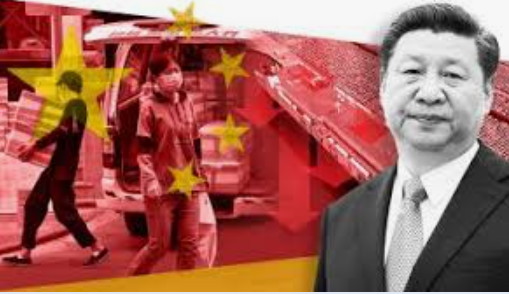

Moody’s Analytics has issued a cautious outlook on China’s near-term economic performance, projecting a deceleration across key indicators as the world’s second-largest economy faces mounting headwinds. The July economic data, scheduled for release on Friday, is expected to reveal weaker momentum in both production and consumption, reflecting a broader slowdown in growth.
The analysis comes on the heels of last week’s figures showing deepening producer price deflation, adding to concerns over subdued domestic demand and fragile business confidence. According to Moody’s, the anticipated data will be a clear signal that China’s post-pandemic recovery is losing steam faster than many policymakers expected.
Retail Sales and Industrial Output Expected to Cool
Moody’s projects that retail sales for July will rise by 4% year-on-year, down from the 4.8% growth recorded in June. This slowdown reflects weaker consumer confidence, a trend exacerbated by stagnant wage growth, a sluggish housing market, and lingering uncertainty over the global economic outlook.
Industrial production growth is also expected to ease from 6.8% to 6.5%, indicating that the manufacturing sector is feeling the pressure of both domestic and external challenges. Export demand remains uneven, particularly given the ongoing trade frictions with the United States and softening global orders.
In addition, fixed asset investment growth is forecast to dip from 2.8% to 2.6%, signaling weaker capital spending amid a cautious corporate environment. Analysts note that companies are reluctant to commit to large-scale projects without clear signs of stronger market demand.
Deflation Concerns Gain Momentum
Last week’s inflation figures underscored the growing risks of deflation. China’s Producer Price Index (PPI) fell by 3.6% year-on-year in July, marking the continuation of a two-year downward trend. Although the decline was less severe than some economists had predicted, it still points to significant weakness in industrial pricing power.
Meanwhile, the Consumer Price Index (CPI) remained unchanged compared to the same month last year, reflecting muted demand pressures. Core inflation, which strips out volatile food and energy prices, rose to 0.8% — the highest in 17 months — but remains far below levels that would indicate robust economic activity.
Economists warn that sustained deflation could weigh heavily on corporate earnings, deter investment, and complicate debt servicing for both companies and local governments.
Government May Roll Out Targeted Stimulus Measures
Moody’s suggests that Beijing may respond to the slowing momentum with new policy measures aimed at boosting growth. Potential options include targeted fiscal spending, tax relief for small and medium-sized enterprises, and monetary easing by the People’s Bank of China.
However, analysts caution that without a meaningful revival in domestic demand, such measures may have only a temporary effect. The persistent weakness in the property market, coupled with fragile trade relations with the United States, continues to pose structural challenges.
The real estate sector, once a key growth driver, remains mired in a prolonged slump, with declining sales, unfinished housing projects, and liquidity stress among major developers. Efforts to stabilize the sector have so far yielded limited results, leaving a gap in China’s growth engine.
Extreme Weather Adds to Economic Strain
July’s economic activity was also hampered by severe weather events. Eastern provinces endured intense heatwaves, disrupting industrial operations and reducing productivity, while northern and southern regions grappled with heavy rainfall and flooding. These conditions disrupted supply chains, slowed transportation, and caused delays in both production and delivery schedules.
The agricultural sector faced particular challenges, with crop damage reported in multiple provinces. This could contribute to localized food price fluctuations, though overall inflationary pressures remain subdued due to weak consumer demand.
Outlook: Slow Recovery and Heightened Risks
The combination of structural economic challenges, geopolitical tensions, and environmental disruptions leaves China facing a delicate balancing act. Policymakers must stimulate growth without stoking financial instability, especially in the context of high local government debt and underperforming state-owned enterprises.
Moody’s emphasizes that while short-term stimulus may offer some relief, the sustainability of China’s growth will depend on deeper reforms to boost productivity, improve investor confidence, and rebalance the economy toward consumption-led expansion.
International investors will be watching Friday’s data closely for signs of whether the slowdown is cyclical or indicative of more entrenched weaknesses. The trajectory of China’s economy in the coming quarters will have significant implications for global trade flows, commodity markets, and regional financial stability.
As uncertainty lingers, the focus remains on whether Beijing can craft a policy mix that revives demand, supports vulnerable sectors, and maintains financial stability. The upcoming months may prove decisive in determining whether China can steer its economy back toward a more sustainable growth path.